
Reading the Language of Empire
A Sasanian silver coin is more than a portrait of a king. Its inscriptions tell you whose authority it carries, where it was struck, and when it was issued. Once you know where to look, a coin that first seems covered in unfamiliar signs becomes a readable historical object.
This guide follows a silver drachm of Khusrau II, who ruled from 590 to 628 CE, with an interruption before his restoration in 591. We will work through four clues: the ruler's name, the royal motto, the mint signature, and the regnal year. The inscriptions are in Middle Persian, written in Pahlavi, rather than modern Persian script.
First orient the two sides. On the obverse, the king faces right beneath a winged crown. On the reverse, a fire altar stands between two attendants. Use the upright portrait and altar to find left and right before trying to read a legend.
| What to look for | Where to look | What it tells you |
|---|---|---|
| Ruler's name | Obverse, in front of the face | The issuing king |
| Royal motto | Obverse, behind the head | A statement about royal glory |
| Mint signature | Reverse, right of the altar | The abbreviated mint designation |
| Regnal year | Reverse, left of the altar | The numbered year of the reign |
These positions describe the familiar Khusrau II drachm layout. They are a useful starting point, not a rule to impose on every Sasanian issue or later imitation.
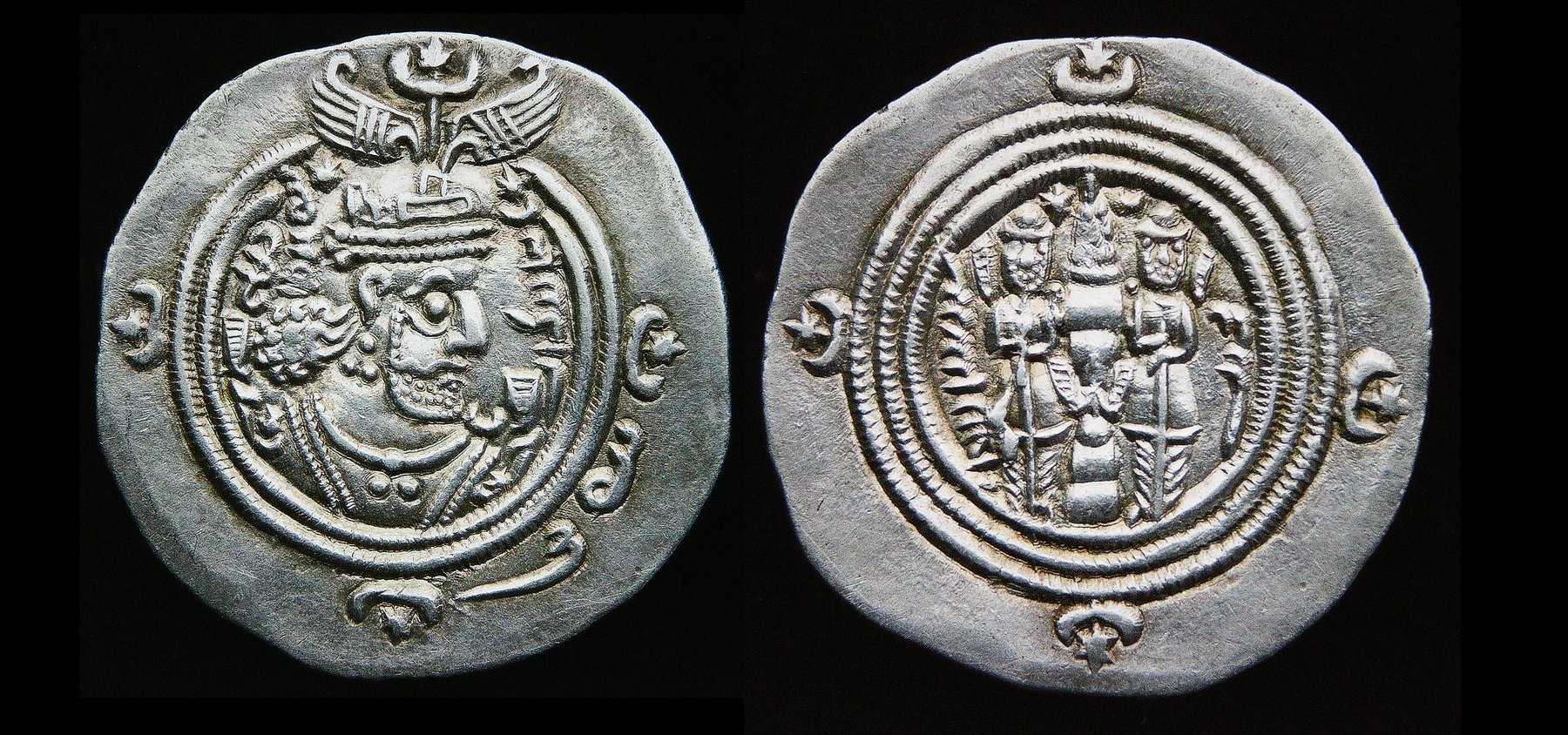
1. Find the Ruler's Name
Start on the right side of the obverse, immediately in front of the king's face. This is where you look for the name Khusrau, also written Khosrow or Khusro in English.
Pahlavi letters can look very different from modern printed characters. Closely related signs may share similar shapes, and wear or a weak strike can make two strokes look like one. Compare the complete name with a reliable illustrated reference instead of identifying the king from a single letter. Museum catalogues may transliterate the name as hwslwb; you will also encounter other scholarly transliteration conventions. The Latin letters represent the ancient spelling, not an English word that you should try to pronounce letter by letter.
The crown gives you a second clue. The familiar restored-reign portrait has prominent wings with a star-and-crescent element above. Use portrait and legend together: a crown can narrow the possibilities, but a similar portrait on a later imitation does not by itself prove the coin was issued during Khusrau II's lifetime.

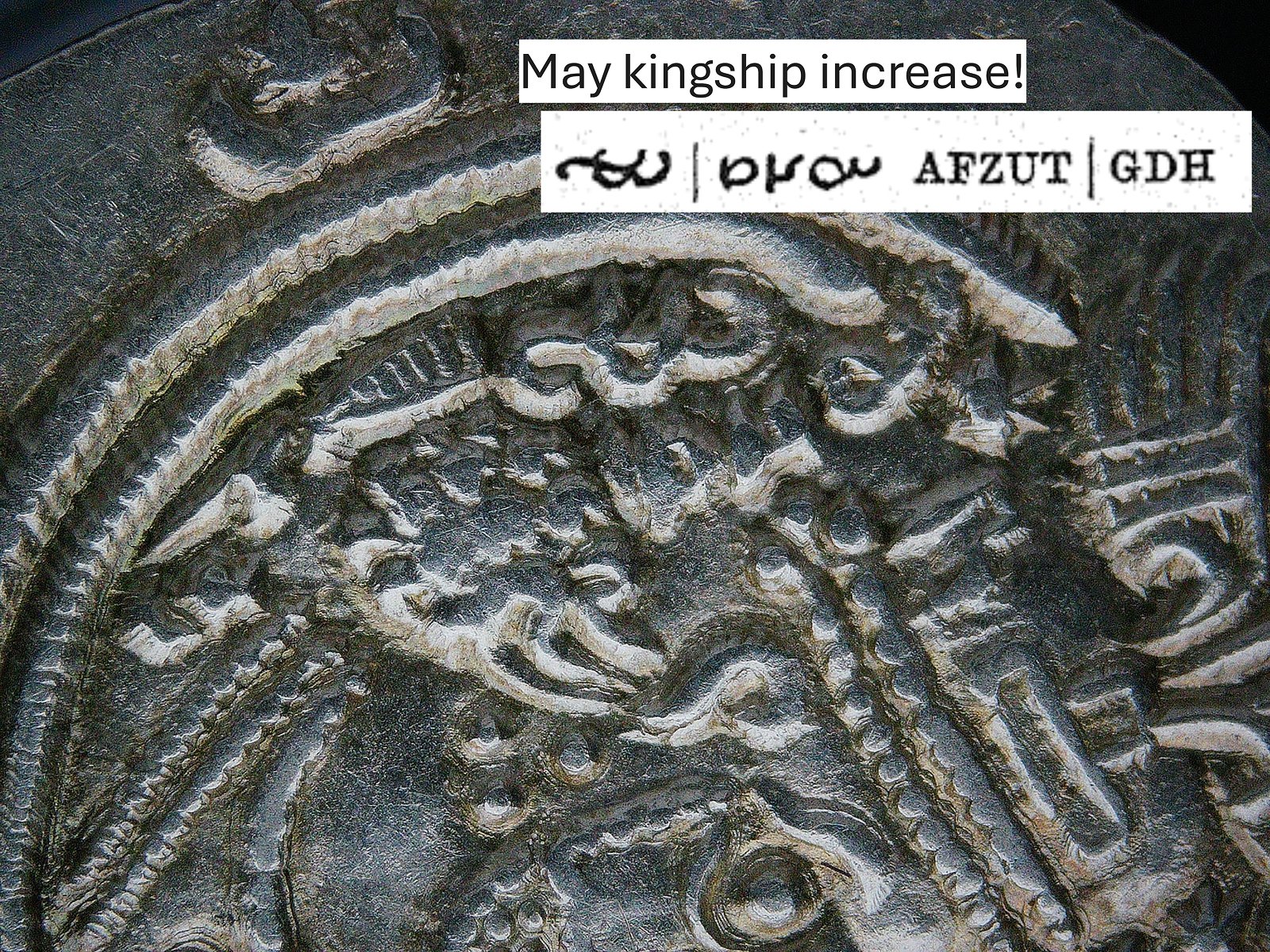
2. Read the Royal Motto
Now move to the left side of the obverse, behind the king's head. The familiar letter groups are often presented to collectors as GDH AFZUT, with variations such as AFZWT in transliteration. GDH is an Aramaic heterogram read as the Middle Persian word xwarrah: royal glory or fortune. The accompanying expression concerns its increase.
Together with the king's name, this is a statement of royal legitimacy, not a second ruler or a mint mark. The British Museum translates the combined legend as "Khusrau has increased the royal glory."
Our original illustration uses the accessible blessing-style wording "May kingship increase!" It conveys the theme, but the museum's reading above is more precise for the combined Khusrau II legend. Do not assume that this exact formula appeared unchanged on every coin throughout the entire Sasanian period.
3. Identify the Mint Signature
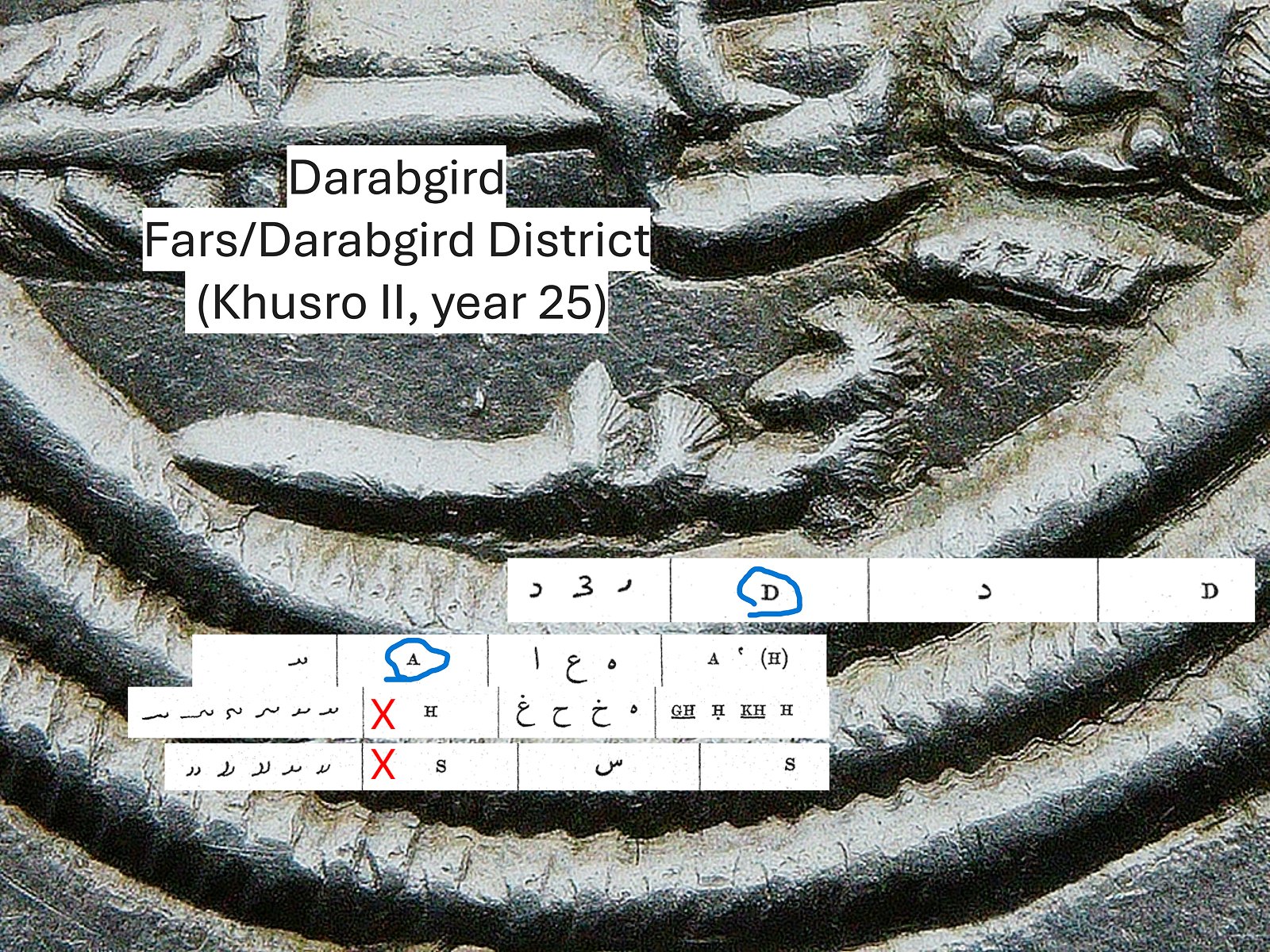
Turn the coin over and orient the fire altar upright. The mint signature is normally to the right of the altar, around the three-o'clock position.
Sasanian mint designations are usually abbreviations, not the full city names written out. In the original worked example, the signature is read as DA, conventionally associated with Darabgird in Fars. This identifies the mint designation carried by the coin; it does not tell you where the coin was later found or collected.
Copy the visible signs before opening a mint table. Then compare their shapes with a securely catalogued example. Some signatures have disputed identifications, and superficially similar letters can lead to quite different attributions. If the strike does not preserve enough of the inscription, record the mint as uncertain rather than filling in a familiar name.
The original mint illustration includes a year-25 label in its teaching annotation. That label belongs to the comparison material and must not replace the separate year-26 reading used in the next step.
4. Read the Regnal Year
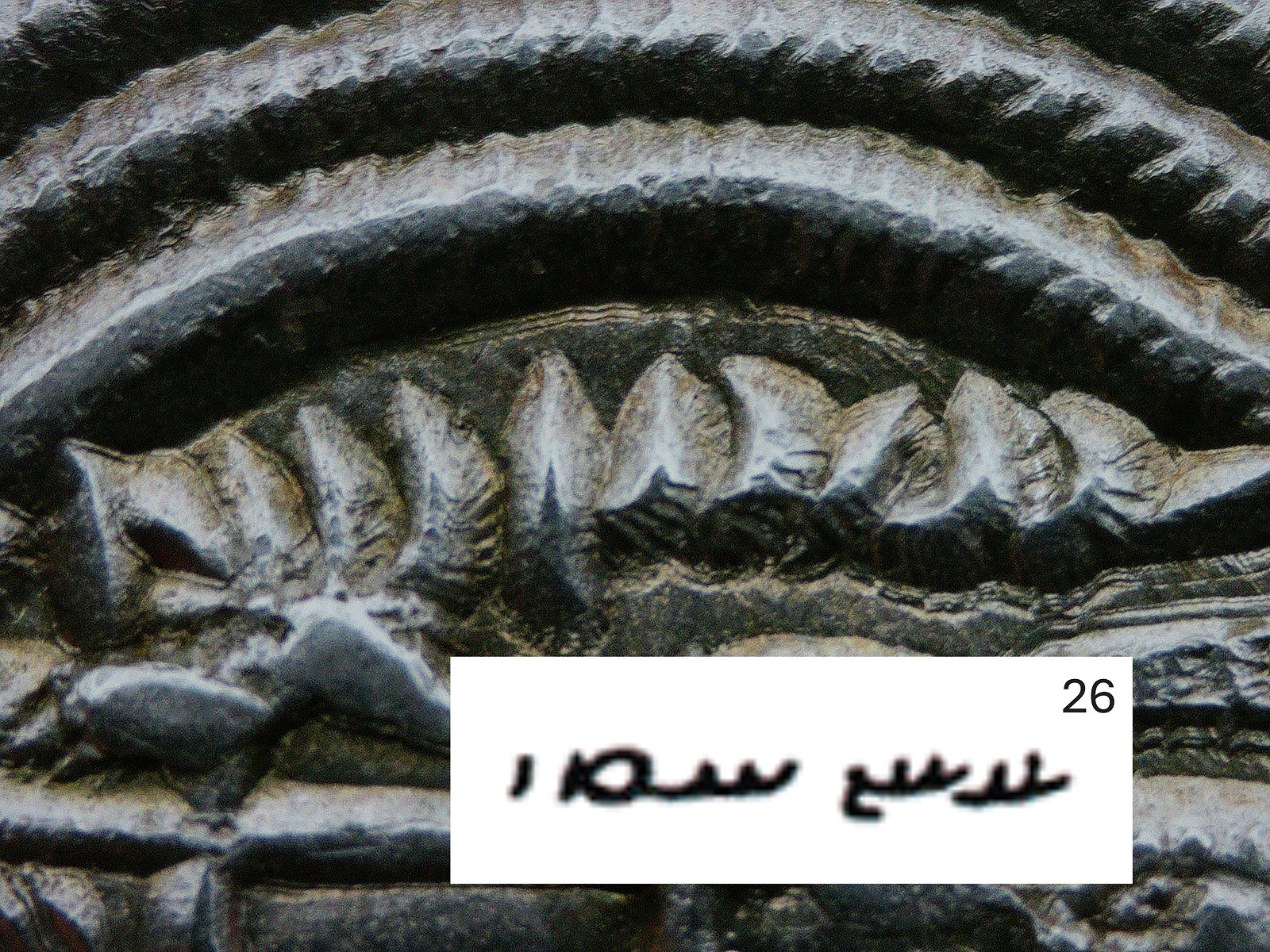
The date sits on the left side of the reverse, around the nine-o'clock position. It records a regnal year, meaning a numbered year of the ruler's reign, not a modern calendar date. The worked example is read as year 26.
Use a Pahlavi date chart and compare the whole expression. Small strokes matter, particularly where an inscription is worn, struck off the flan, or interrupted by an uneven surface.
For Khusrau II, year 26 corresponds approximately to 615-616 CE in the chronology used here. The simple calculation starts with year 1 in 590-591 and adds 25, not 26: 590 + (26 - 1) = 615. The two-calendar-year range reminds us that a regnal year is not the same as a January-to-December year. Khusrau's restoration in 591 did not make the familiar year-26 issues a fresh count beginning at year 1.
This corrects the original guide's 616-617 conversion. For precise dating, use the ruler's published chronology rather than applying a universal accession-year formula to every Sasanian coin.
Bonus Detail: The Marginal APD Inscription
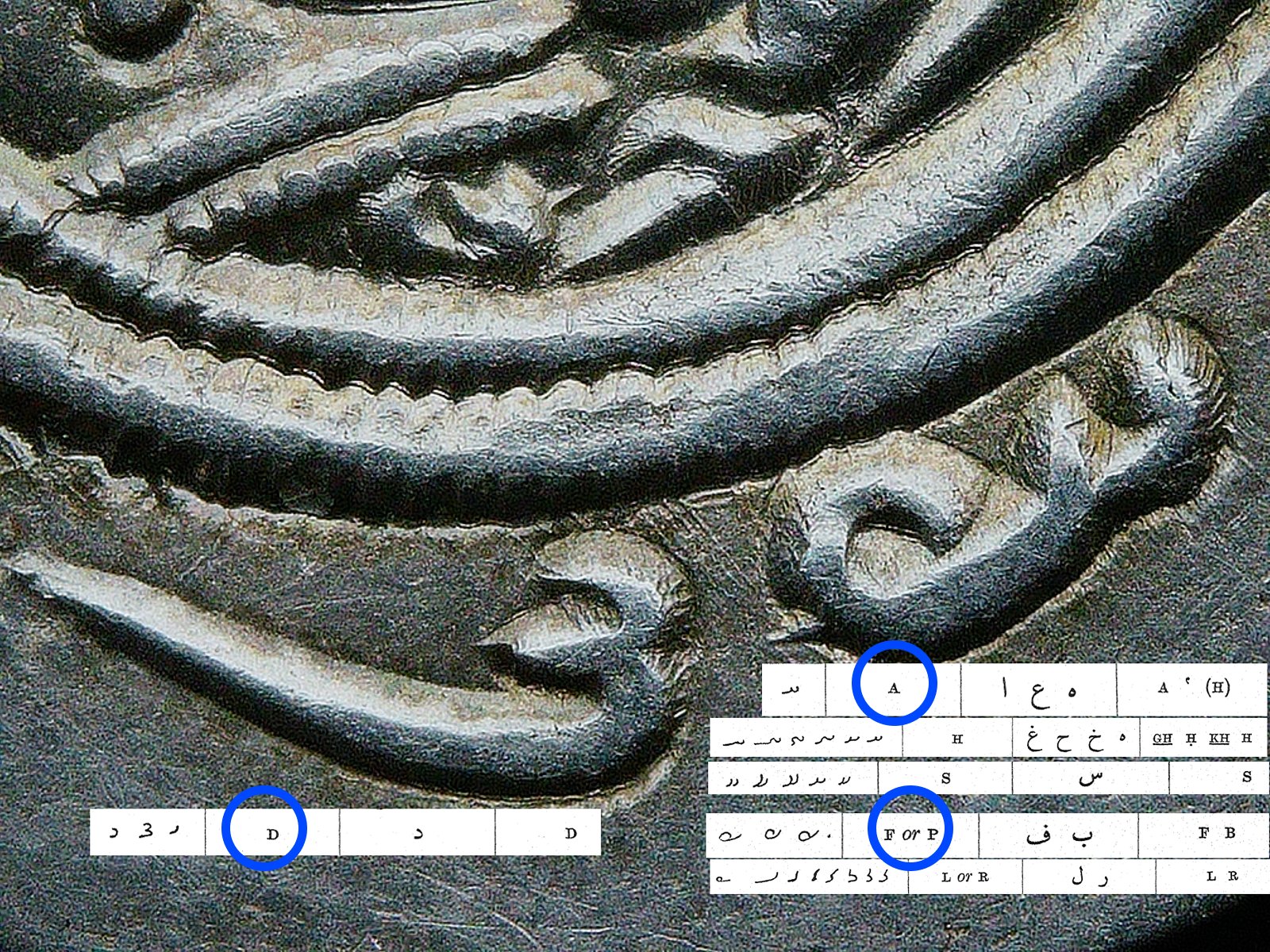
After reading the main fields, inspect the outer obverse margin. Some Khusrau II drachms carry the additional inscription usually transliterated 'pd, or APD in collector shorthand. It is distinct from the ruler's name, mint signature, and date.
The British Museum records this marginal expression as praise. Its significance has been discussed in specialist literature, but the letters alone do not identify an engraver or establish a particular die workshop. The original version of this guide treated it too confidently as a control mark or signature; that conclusion is not retained here.
Its presence is still worth recording. Note its position, whether the entire letter group survives, and whether the surrounding margin has been clipped or worn. Absence from a photograph may mean the relevant area is missing, not necessarily that the die lacked the inscription. Treat it as an additional descriptive feature, not a shortcut to a precise date or authenticity verdict.
Reading Tips for Collectors
- Start with the crown and portrait. Establish a likely ruler, then check the name rather than relying on the crown alone.
- Orient both sides independently. The reverse may be rotated relative to the obverse. Left and right only become useful after the altar is upright.
- Separate the four main fields. Royal name and motto belong on the obverse; mint signature and regnal year belong on the reverse.
- Use a loupe or sharp macro photographs. Look for actual strokes rather than reflections, scratches, or the edges of corrosion. Avoid cleaning a coin just to expose a letter.
- Compare more than one reference specimen. Different dies, strike quality, and wear can make the same inscription look surprisingly different.
- Write down uncertainty. A tentative reading is more useful than a confident attribution built on missing letters.
- Record the complete object. Keep obverse and reverse photographs together, along with any measured weight and diameter. Never borrow another specimen's measurements for your coin.
A useful identification note brings the readings together: Khusrau II; silver drachm; DA / Darabgird; regnal year 26, approximately 615-616 CE, with any uncertainty stated alongside the reading. This is the original guide's worked attribution, not a claim that every Khusrau II drachm in our gallery has the same mint or date.
Every Coin Is a Lesson in Empire
You do not need to become fluent in Middle Persian to begin reading a Sasanian coin. Learn the layout, identify familiar groups of signs, and build a habit of checking each reading against good references. The portrait, royal-glory legend, mint signature, and date together turn a small silver object into a record of kingship and administration.
The next time you hold a Khusrau II drachm, look beyond the portrait. Ask four questions: whose name, which formula, which mint, and which year? Each answer brings the coin a little closer to the world in which it was made.
References
- James Howard-Johnston, Khosrow II, Encyclopaedia Iranica. Reign, accession and restoration; regnal years 26-28 are given as 615/6-617/8.
- British Museum, Khusrau II drachm OR.163. Bishapur comparison specimen, regnal year 37; catalogue description and transcription of the name, royal-glory formula, mint, date, and marginal praise. Not the TerraNumis teaching specimen.
- Nikolaus Schindel, Sasanian Coinage, Encyclopaedia Iranica. Background on coin types, legends, denominations and the interpretation of mint signatures.
- British Museum, Darabgird mint records. Collection place authority and associated coin records; comparative mint attribution, not a certificate for the illustrated coin.
- TerraNumis, How to Read a Sasanian Coin: A Guide Using Khusrau II's Silver Drachm. Original article published May 23, 2025, by TerraNumis; source of the worked DA / year-26 example and all six supplied teaching illustrations. Updated here rather than replaced by a generic series study.
- NumisWiki, Sasanian Dates. Illustrated collector reference for comparing Pahlavi date expressions; use together with ruler-specific chronological research.
- Stefan Heidemann, Josef Riederer and Dieter Weber, A Hoard from the Time of Yazdgard III in Kirman. Iran 52 (2014); discussion of the disputed meaning and use of APD, including erasure and die-sharing observations.
- Photographs and teaching illustrations copyright TerraNumis · All rights reserved